11×14in
Acrylic
“Revolutionary Rest”
It brings me great joy to see landscapers and construction workers commune with each other on their lunch breaks. I enjoy witnessing them at rest. Culturally, so much guilt and stigma comes with idle hands - it’s “lazy” to stop working.
Leading up to the Mexican-American War (1846–1848), as a way to justify conquering Mexican territories, early American travelers and literature explicitly argued that Mexicans were too lazy to properly cultivate their resource-rich lands. By 1879, the trope was so deeply entrenched that The New York Times openly ran headlines referencing "Lazy Mexicans". Through the 1940s and 1950s tourist stops began to subvert art like Diego Rivera’s Sleep (portraying people collapsed in fatigue after backbreaking, underpaid work) into kitch souvenoirs of the “Sleeping Mexican” that further established the trope.
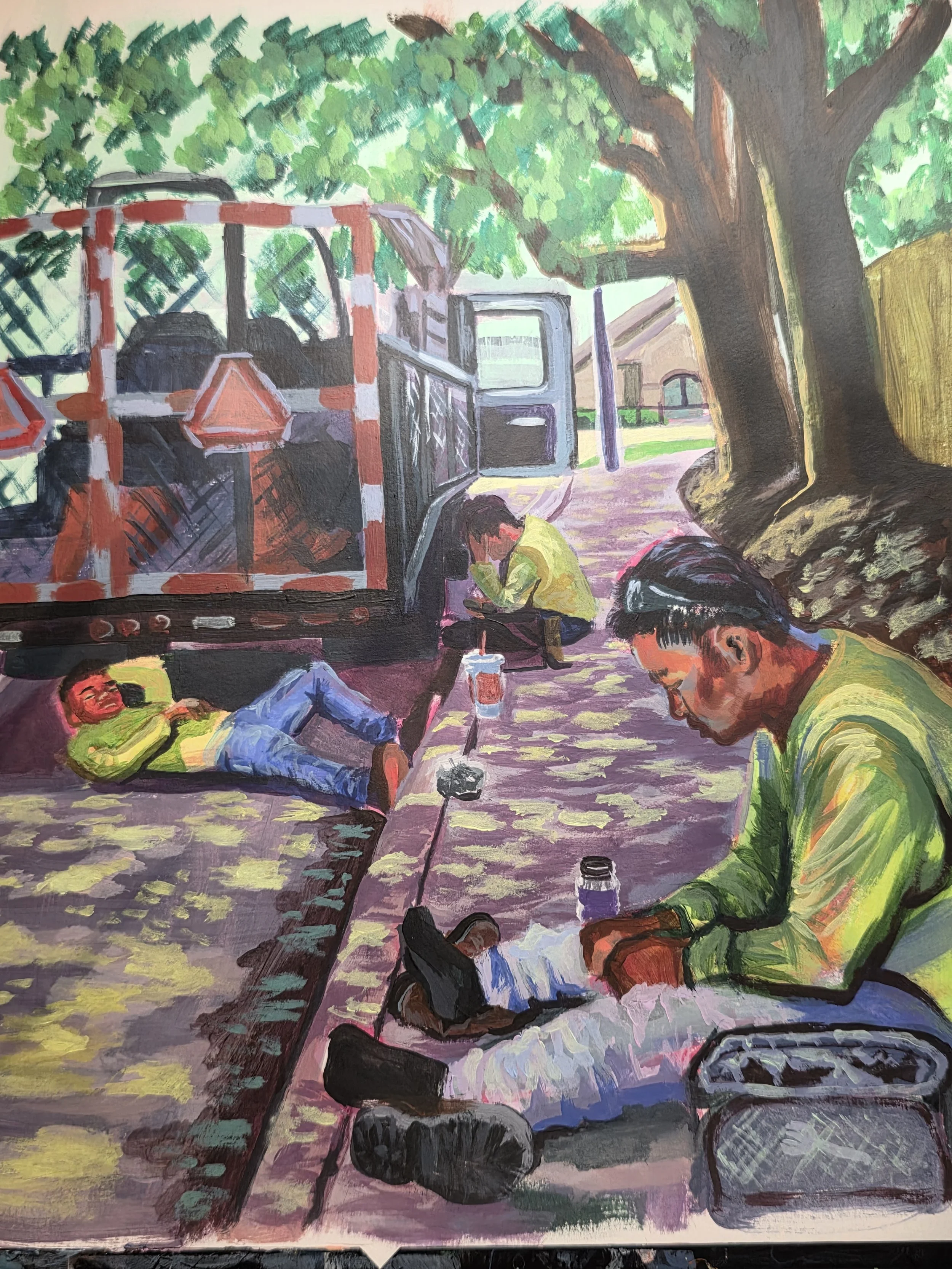 Image 1 of 1